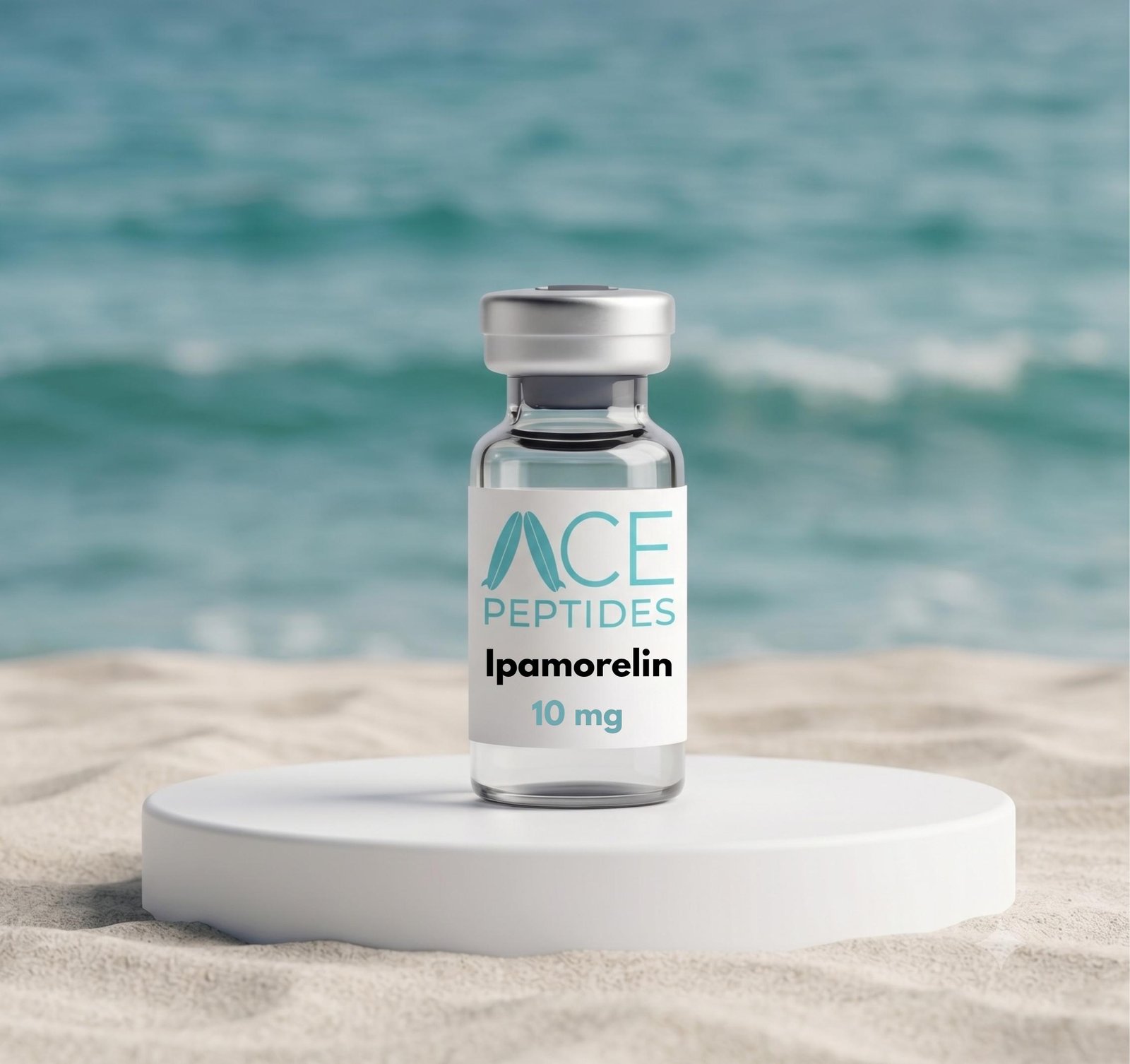
Ipamorelin ACE Peptides Philippines
🔜 Coming Soon

Ipamorelin

The selective growth hormone secretagogue. Pulses natural GH release through GHS-R1a with no meaningful cortisol, prolactin or ACTH elevation — the cleanest-acting GHRP-class compound in research use.

GHS-R1a
Receptor Target
0
Cortisol/ACTH Rise
≥99%
Purity
Select size
✅ Kit included with every order
🧪 Drawing syringe 💉 Insulin syringes 🧴 Alcohol pads 💧 BAC Water 3ml 📦 Secure packaging
Contact us for pricing
Contact via WhatsApp
Fast nationwide shipping · Research purposes only
The Science

What is Ipamorelin?

Ipamorelin is a synthetic pentapeptide developed by Novo Nordisk and derived from GHRP-1, engineered specifically to solve the biggest problem with earlier growth hormone-releasing peptides: lack of selectivity. It works as a ghrelin mimetic, binding the growth hormone secretagogue receptor (GHS-R1a) on somatotroph cells in the anterior pituitary and triggering a natural, pulsatile release of the body's own stored growth hormone.

What made Ipamorelin notable from its original 1998 characterization onward is what it doesn't do. At doses that reliably release GH, it does not meaningfully raise ACTH, cortisol, prolactin, FSH, LH or TSH — a sharp contrast to older secretagogues like GHRP-2 and GHRP-6, which stimulate GH release but also disturb the broader hypothalamic-pituitary-adrenal axis. Because Ipamorelin works through the pituitary's own reserves rather than introducing exogenous hormone, the body's natural negative-feedback loops stay intact.

🧬
Selective by design, not by accident
Ipamorelin's receptor selectivity was engineered specifically to avoid the off-target endocrine effects of first-generation GHRPs. It is often researched alongside CJC-1295, a GHRH analogue that extends and amplifies the GH pulse Ipamorelin initiates.
Mechanism

How Ipamorelin triggers a clean GH pulse

Ipamorelin's action runs through a single, well-defined pathway rather than the broad, multi-receptor activation seen with older GHRPs:

🔑
GHS-R1a Binding
Binds the ghrelin receptor on pituitary somatotrophs, triggering Gq/phospholipase C signalling, IP3 generation and intracellular calcium release.
Mimics natural ghrelin pulses
📈
Pulsatile GH Release
Releases GH from the pituitary's existing stores in a physiological pulse, rather than sustaining artificially elevated hormone levels.
Natural feedback loops preserved
🎯
Receptor Selectivity
Does not meaningfully cross-activate the receptors responsible for cortisol, prolactin, ACTH, FSH, LH or TSH release, even at supraphysiological doses.
No HPA-axis disturbance
The Evidence

What the research actually shows

Ipamorelin has one of the more honest evidence pictures in the research-peptide space, and it's worth stating plainly: most of the rigorous data is preclinical, and Ipamorelin's only completed peer-reviewed human RCT wasn't even testing its growth-hormone effects.

1998
Original Characterization
Raun et al., European Journal of Endocrinology
1
Completed Human RCT
Beck et al. 2014 — postoperative ileus, not GH endpoints
14%
GH Decline Per Decade
Age-related somatopause after age 20
StudyModelFinding
Raun et al., 1998Rats, pigs, isolated pituitary cellsFirst selective GH secretagogue characterized — GH release without ACTH/cortisol rise, even at high doses Foundational
Malmlöf et al., 1999Glucocorticoid-treated ratsRepeated dosing raised IGF-1 and significantly reduced methylprednisolone-induced weight loss (p<0.05); GH-IGF-1 axis stayed responsive under steroid exposure
Ovariectomized rat modelsBone density researchInvestigated for effects on bone mineral density in an osteoporosis-relevant model
Beck, Sweeney & McCarter, 2014Human RCT, bowel resection patientsTested gastroprokinetic effect on postoperative ileus — a proof-of-concept trial unrelated to GH/IGF-1 outcomes
⚖️
Regulatory status is genuinely in motion
Ipamorelin was placed on the FDA's Category 2 restricted-compounding list in September 2023 alongside 18 other peptides. On February 27, 2026, HHS Secretary Robert F. Kennedy Jr. announced that Ipamorelin was among roughly 14 of those 19 peptides expected to return to Category 1 status; the FDA's formal Federal Register action followed on April 15, 2026, with the removal from Category 2 effective April 23, 2026. Formal clearance for 503A compounding pharmacies is still pending Pharmacy Compounding Advisory Committee review. This reflects an evolving regulatory pathway, not a finding of harm. All ACE Peptides products are supplied for research purposes only.
Stack Synergy

Why Ipamorelin is almost always paired with CJC-1295

Ipamorelin triggers the GH pulse; CJC-1295, a GHRH analogue, extends and amplifies it. Ipamorelin opens the tap through the ghrelin receptor pathway — CJC-1295 works a completely different receptor (the GHRH receptor) to raise the pituitary's baseline responsiveness and prolong how long GH stays elevated after each pulse. Different receptors, complementary timing, no overlap — the standard research combination for sleep quality, recovery and body composition research.

🌙
Why timing matters
GH secretion naturally peaks during deep sleep. Ipamorelin is typically dosed before bed to align the induced pulse with the body's own nocturnal GH rhythm, rather than fighting against it.
Research Protocol

Suggested research protocol

1
Reconstitute
Reconstitute the lyophilised vial with bacteriostatic water. Use the free ACE Peptides reconstitution calculator to get an exact syringe mark for your target dose.
2
Time it to sleep
Most research protocols dose subcutaneously 30–60 minutes before bed, and on an empty stomach, to align with the body's natural nocturnal GH pulse and avoid blunting from circulating glucose or free fatty acids.
3
Store cold
Store lyophilised powder refrigerated or frozen; once reconstituted, keep refrigerated and use within the timeframe recommended for peptide stability.
4
Cycle, don't run continuously
Research protocols typically run in defined blocks rather than indefinitely, allowing assessment of the pituitary's continued responsiveness over time.
FAQ

Frequently asked questions

How is Ipamorelin different from GHRP-2 or GHRP-6?
All three are ghrelin-receptor agonists that release growth hormone, but GHRP-2 and GHRP-6 also meaningfully raise cortisol, prolactin and ACTH at effective doses — disturbing the broader hypothalamic-pituitary-adrenal axis. Ipamorelin was specifically engineered for GHS-R1a selectivity, releasing GH with minimal off-target hormonal disturbance, even at doses well above what's needed for GH release.
Is there strong human clinical trial data for Ipamorelin?
Be direct about this: as of 2026, there is one completed, peer-reviewed randomized controlled trial of Ipamorelin in humans, and it tested the compound's gastroprokinetic effect on postoperative ileus recovery — not its growth-hormone activity. The GH-selectivity profile is well established in preclinical models (rats, pigs, isolated pituitary cells) going back to its original 1998 characterization, but rigorous human trial data on GH/IGF-1, body composition or sleep outcomes remains limited.
Why is Ipamorelin usually paired with CJC-1295?
They act on two different receptors with complementary timing. Ipamorelin binds GHS-R1a to trigger a GH pulse; CJC-1295 binds the GHRH receptor to raise pituitary responsiveness and extend how long GH stays elevated after that pulse. Neither compound substitutes for the other — together they produce a larger, longer GH pulse than either alone.
What is Ipamorelin's regulatory status in 2026?
Ipamorelin was placed on the FDA's Category 2 restricted-compounding list in September 2023. Following the nominator's withdrawal, HHS Secretary Robert F. Kennedy Jr. announced on February 27, 2026 that Ipamorelin was expected to return to Category 1; the FDA's formal action followed April 15, 2026, effective April 23, 2026. Formal 503A compounding clearance from the Pharmacy Compounding Advisory Committee is still pending. This is a regulatory pathway change, not a safety finding — Ipamorelin remains investigational and is not FDA-approved for any therapeutic use.
How do I calculate my dose?
Use the free ACE Peptides reconstitution calculator. Enter your vial size, how much bacteriostatic water you added, and your desired dose — the calculator gives you the exact syringe mark instantly.
References

Research sources

Raun K, et al. Ipamorelin, the first selective growth hormone secretagogue. Eur J Endocrinol. 1998;139(5):552-561.
Malmlöf K, et al. Growth hormone secretagogues protect against glucocorticoid-induced catabolism. Growth Horm IGF Res. 1999.
Beck DE, Sweeney WB, McCarter MD. Prospective, randomized, controlled, proof-of-concept trial of the Ghrelin mimetic ipamorelin for the management of postoperative ileus. Int J Colorectal Dis. 2014.
Semenistaya E, Zvereva I, et al. Determination of Ipamorelin metabolites in human/equine urine by LC-MS. Drug Test Anal. 2015.
World Anti-Doping Agency. 2026 Prohibited List — Category S2, Peptide Hormones, Growth Factors, Related Substances and Mimetics.
FDA Federal Register notice, April 16, 2026 — removal of 12 peptide bulk drug substances from Category 2, effective April 23, 2026.
HHS Secretary Robert F. Kennedy Jr., public announcement, February 27, 2026 — reclassification of approximately 14 of 19 restricted peptides.
FDA Pharmacy Compounding Advisory Committee — scheduled review, July 23–24, 2026.
Complete your protocol

Works well with