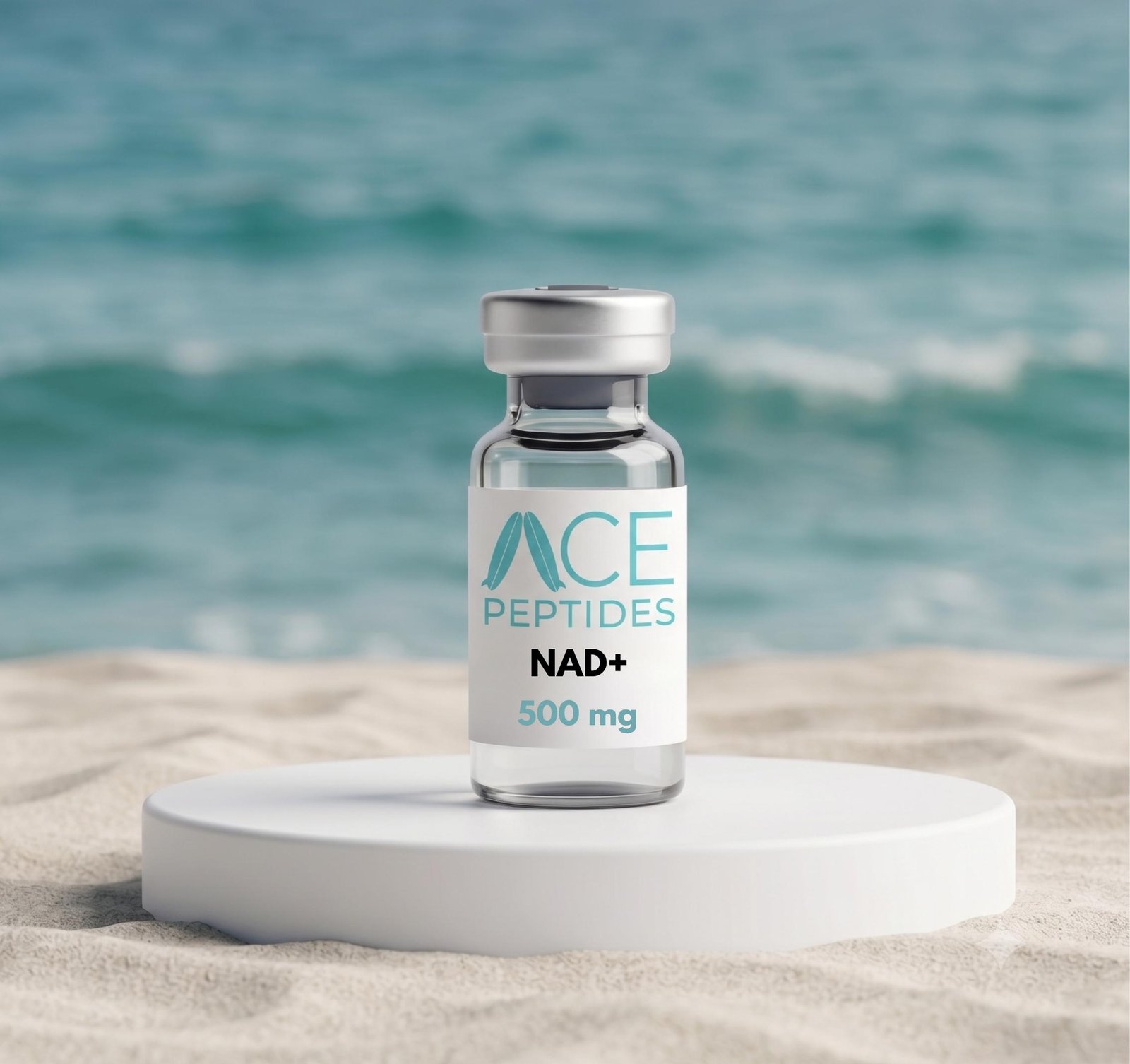
NAD+ ACE Peptides Philippines
🔜 Coming Soon

NAD+

The longevity molecule. Declines 50% by age 60. Five hallmarks of ageing addressed simultaneously from a single coenzyme.

500+
Enzymatic Reactions
50%
Age-Related Decline
5
Hallmarks of Ageing
Select size
✅ Kit included with every order
🧪 Drawing syringe 💉 Insulin syringes 🨄 Alcohol pads 💧 BAC Water 3ml 📦 Secure packaging
Contact us for pricing
Contact via WhatsApp
Fast nationwide shipping · Research purposes only
The Science

What is NAD+?

Nicotinamide Adenine Dinucleotide (NAD+) is a coenzyme found in every living cell, involved in over 500 enzymatic reactions spanning energy metabolism, DNA repair, gene expression regulation, immune function and cellular stress response. It is the electron carrier that powers the mitochondria, the substrate that fuels DNA repair enzymes, and the activator of sirtuins — the “longevity enzymes” that regulate ageing itself.

The central scientific finding driving NAD+ research is its age-related decline: cellular NAD+ levels at age 60 are roughly half what they were at age 20. This decline correlates directly with reduced sirtuin activity, impaired PARP-mediated DNA repair and mitochondrial dysfunction — three of the nine established Hallmarks of Ageing. Restoring NAD+ addresses multiple hallmarks simultaneously from a single molecule.

The injectable form provides meaningfully higher and more reliable plasma NAD+ concentrations than oral precursors (NMN, NR) by bypassing first-pass hepatic metabolism — a pharmacokinetic advantage that matters particularly for neurological and mitochondrial applications.

~50%
Age-related decline
Plasma levels at age 60 vs age 20
500+
Enzymatic reactions
Cofactor or substrate across all major metabolic pathways
SIRT1–7
Sirtuins activated
All 7 longevity-linked sirtuin enzymes are entirely NAD+-dependent
Hallmarks of Ageing

Five hallmarks addressed simultaneously

The Hallmarks of Ageing framework identifies the primary molecular drivers of biological ageing. NAD+ decline intersects with at least five, making it uniquely positioned among longevity research compounds.

Hallmark 1
Genomic Instability — PARP & DNA Repair
PARP enzymes are the primary responders to DNA strand breaks — entirely NAD+-dependent. PARP activity can increase 500-fold in response to damage, consuming enormous NAD+. When NAD+ is depleted by age, PARP cannot function and DNA damage accumulates. NAD+ restoration restores PARP capacity.
Hallmark 2
Epigenetic Alterations — Sirtuin Deacetylases
Sirtuins (SIRT1–7) are NAD+-dependent histone deacetylases regulating gene expression. SIRT1 and SIRT6 operate in the nucleus for DNA repair. SIRT3 operates in mitochondria for metabolic regulation. Rare SIRT6 variants are enriched in human centenarians — the direct human longevity link.
Hallmark 3
Mitochondrial Dysfunction — ATP Production
NAD+ is the central electron carrier in oxidative phosphorylation — the process by which mitochondria produce ATP. When NAD+ declines, the entire energy-producing cascade is impaired. NAD+ restoration restores mitochondrial function in ageing models.
Hallmark 4
Cellular Senescence — Inflammatory SASP
Low NAD+ impairs SIRT1, which normally suppresses NF-κB-driven inflammation. The result: NAD+ decline → reduced SIRT1 → NF-κB activation → increased CD38 → further NAD+ depletion. A self-reinforcing loop NAD+ repletion can break.
Hallmark 5
Deregulated Nutrient Sensing — AMPK
NAD+ regulates SIRT1 which activates AMPK — the master metabolic switch governing glucose uptake and mitochondrial biogenesis. Human NMN trials show improvements in insulin sensitivity and muscle glucose uptake in older adults.
Why It Matters
Upstream vs Downstream
Most longevity interventions address individual hallmarks downstream. NAD+ sits upstream — its decline is a cause of multiple hallmarks simultaneously. This makes NAD+ restoration one of the most mechanistically compelling longevity research targets available.
The Cascade

How NAD+ decline drives ageing

Two self-reinforcing loops accelerate once NAD+ begins to decline. NAD+ repletion interrupts both simultaneously.

Loop 1 — DNA Damage Cascade
DNA Damage
PARP (500×)
NAD+ depleted
SIRT1 down
More DNA damage
Loop 2 — Inflammation Cascade
Inflammation
CD38 up
NAD+ consumed
SIRT1 down → NF-κB up
More inflammation
Injectable vs Oral

Why injectable NAD+ vs NMN or NR supplements

FactorInjectable NAD+Oral NMN / NR
RouteDirect — bypasses hepatic first-pass AdvantageOral → gut → liver conversion → NAD+
Peak plasma NAD+High, rapid, reliable AdvantageLower, delayed, subject to conversion efficiency
Neurological reachSuperior — high plasma peak aids CNS delivery AdvantageLimited by conversion ceiling
ConvenienceRequires injectionOral capsule — no preparation
Human RCT dataEmerging IV/SubQ studiesMore published RCTs available
Side effectsIV: flushing (rate-dependent); SubQ: generally mildMild GI effects only
Human Evidence

What the human trials show

💪
Muscle Function & Insulin Sensitivity — NMN RCTs
Multiple human NMN trials demonstrate improvements in insulin sensitivity and muscle glucose uptake in older adults. The strongest human signals are in metabolic dysfunction contexts — insulin resistance, peripheral artery disease, Parkinson’s disease and prediabetes. NMN and NR reliably raise blood NAD+ in humans — that is well established.
🧠
Neurological — Parkinson’s CSF Study
A Bergen group found NR supplementation in newly-diagnosed Parkinson’s patients produced decreased markers of mitochondrial defects in cerebrospinal fluid, alongside reduced pro-inflammatory cytokines. Upcoming 2026 human trials are examining NAD+ precursors in Alzheimer’s, Parkinson’s, long COVID and multiple sclerosis — the most active frontier in NAD+ clinical research.
⚖️
The Honest Scientific Position (2026)
NMN and NR reliably raise blood NAD+. Whether that elevation translates to meaningful longevity outcomes in healthy adults is still being established. The mechanistic science is solid. The human longevity endpoint is promising but unproven. NAD+ repletion is biologically well-motivated — the distinction that matters is between mechanistic plausibility (strong) and proven human longevity benefit (still emerging).
Stack Synergies

NAD+ in the longevity stack

🔋 NAD+ + Retatrutide — Metabolic Longevity Protocol

Retatrutide’s triple GLP-1/GIP/Glucagon agonism drives fat loss through receptor signalling. NAD+ addresses the underlying cellular energy infrastructure. Visceral fat reduction reduces CD38-driven NAD+ consumption — making the two compounds mechanistically complementary for metabolic longevity research.

Research Protocol

Suggested research protocol

1
Reconstitution
Dissolve 500mg in 5ml BAC water for a 100mg/ml solution. NAD+ is water-soluble and reconstitutes readily. Use the ACE Peptides calculator for exact syringe marks.
2
Routes of administration
Subcutaneous: most practical for ongoing protocols. Flatter absorption curve, more stable plasma NAD+, generally well tolerated. IV infusion: highest plasma peak but requires clinical supervision. Commonly causes flushing that resolves with slower rate (1–2 hours).
3
Dose ranges
Subcutaneous: 100–500mg per injection. Human NMN oral trials used 250mg–1g daily. IV clinical sessions: 250–500mg over 1–2 hours. Start conservatively — individual responses vary significantly.
4
Storage
Unreconstituted: −20°C indefinitely. Reconstituted: +4°C for up to 7 days (NAD+ is less stable in solution — use promptly). Keep away from light and heat.
FAQ

Frequently asked questions

What is included in the kit?
Every NAD+ order includes: drawing syringe, insulin syringes, alcohol pads, 3ml BAC water, and secure discreet packaging.
Can I buy just the vial without the kit?
Yes — contact us via WhatsApp and we will accommodate you. Contact us →
What is the difference between NAD+, NMN and NR?
NMN and NR are precursors the body converts into NAD+ through enzymatic pathways. Injectable NAD+ bypasses conversion entirely — delivering NAD+ directly to the bloodstream without hepatic first-pass metabolism for higher, more reliable plasma concentrations.
Why does NAD+ decline with age?
Multiple age-related processes consume NAD+: PARP overactivation from increasing DNA damage, CD38 upregulation driven by chronic inflammation, declining NAMPT enzyme activity, and reduced dietary precursor conversion. The result is a self-reinforcing depletion cycle where the conditions of ageing consume NAD+ faster while aged biology produces it more slowly.
Does NAD+ cause flushing?
IV administration commonly causes flushing, chest tightness and nausea that are dose and rate-dependent — managed by reducing infusion rate. Subcutaneous administration is generally well tolerated without significant flushing. Starting with lower doses and titrating up is standard practice.
Can I buy NAD+ in the Philippines?
ACE Peptides supplies NAD+ as a research compound across the Philippines — Manila, Cebu, Davao, Siargao and all major cities. Enquiries via WhatsApp, discreet nationwide shipping. All products are for research purposes only.
How do I calculate my dose?
Use the free ACE Peptides reconstitution calculator — enter your vial size, BAC water volume and target dose for an exact syringe mark.
References

Research sources

ChemRxiv. “Boosting NAD+ for Anti-Aging: Mechanisms, Interventions, and Opportunities.” July 24, 2025.
ScienceDirect. Human trials exploring anti-aging medicines. 2024. NAD+, centenarian SIRT6 variants, sirtuin longevity framework.
Gethealthspan.com. “NAD+ Injections: Evidence, Protocols, and Who Actually Benefits.” April 27, 2026. Injectable vs oral PK, five hallmarks.
WikiPathways WP3630. NAD+ metabolism, sirtuins and ageing. Two self-reinforcing loops. May 2025.
NST Research. “NAD+ Research: Sirtuins, PARP, DNA Repair and Mitochondrial Function.” March 2026.
Bergen group. NR in newly-diagnosed Parkinson’s — decreased CSF mitochondrial defect markers and reduced pro-inflammatory cytokines.
Martens et al. NMN/NR human bioavailability and safety. NAD+ blood elevation confirmed in multiple RCTs.
Complete your protocol

Works well with