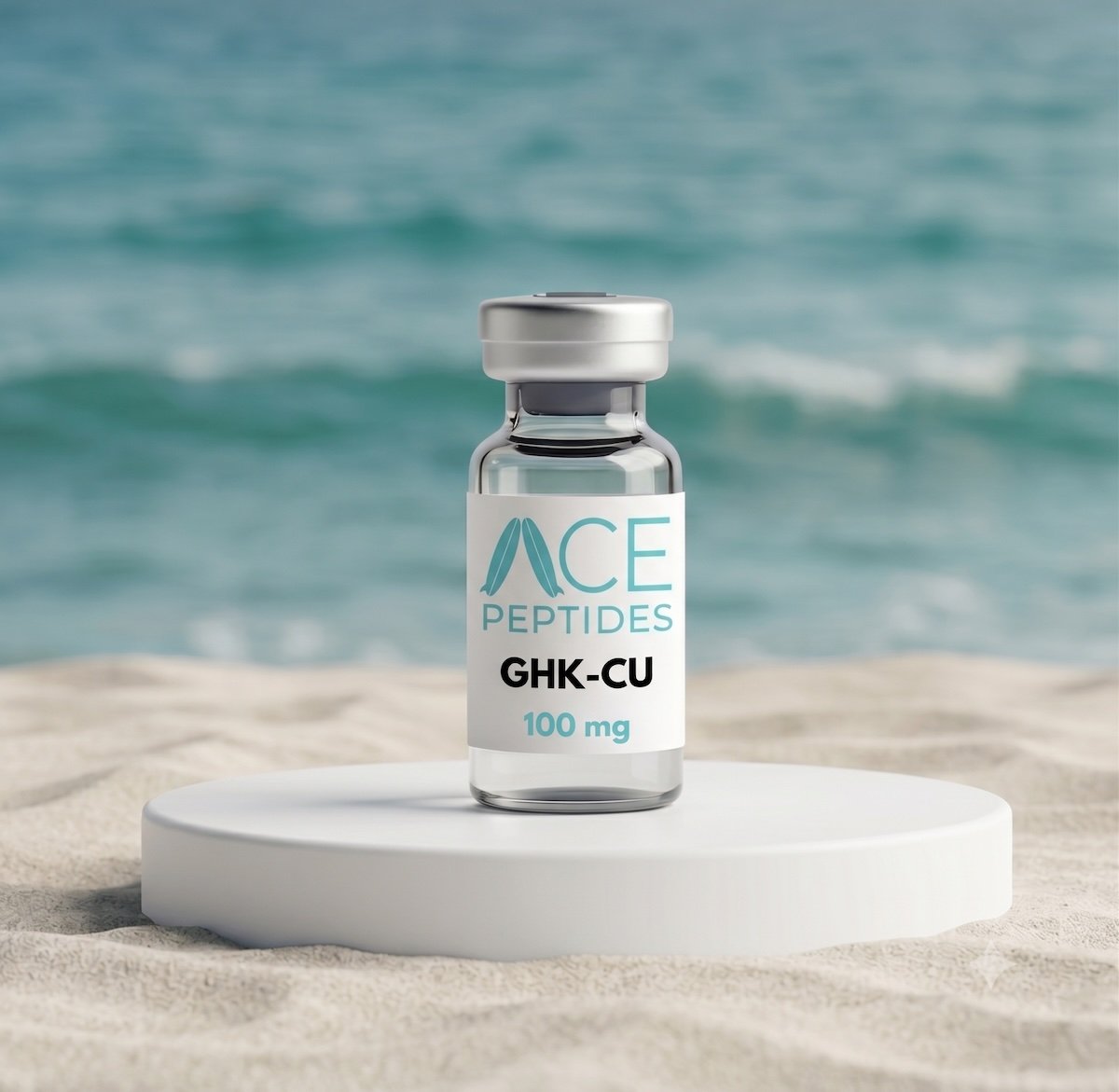
The copper peptide that activates 4,192 human genes. Collagen, elastin, hair growth and wound healing — the original glow.
GHK-Cu (Glycine-Histidine-Lysine Copper complex, also known as Copper Tripeptide-1) is a naturally occurring tripeptide first isolated in 1973 by Dr. Loren Pickart, who observed that albumin from young human plasma restored regenerative function in aged liver cells — while albumin from older donors did not. The active factor turned out to be a small copper-binding tripeptide. Over the following five decades, Pickart and hundreds of independent research groups have mapped GHK-Cu's biology across wound healing, dermatology, hair biology, neurology and oncology.
GHK-Cu is found naturally in human plasma, saliva and urine — and declines significantly with age. Plasma concentrations fall from approximately 200 ng/ml at age 20 to around 80 ng/ml by age 60. This age-related decline correlates with measurable reductions in tissue repair capacity, skin quality and wound healing speed. Supplementing GHK-Cu restores the concentration gradient that drives its regenerative biological activity.
What distinguishes GHK-Cu scientifically is its extraordinary biological reach. A Broad Institute analysis using the Connectivity Map database — the most comprehensive gene expression profiling applied to GHK-Cu — found that it modulates approximately 4,192 human genes: over 30% upregulated (collagen, elastin, antioxidant defence, repair) and the remainder downregulated (inflammatory, fibrotic, apoptotic pathways). No other single tripeptide has demonstrated this breadth of transcriptomic influence.
The 2026 Peptides Lab UK reference and the Pickart & Margolina 2018 review in Int J Mol Sci (PMID 29986520) identified the principal mechanisms through which GHK-Cu's 4,192-gene transcriptomic signature translates into its observed biological effects.
The Broad Institute Connectivity Map analysis assessed GHK-Cu against 13,000 gene probes. The results positioned GHK-Cu's gene expression signature as one of the broadest of any known small molecule. Key pathway activations:
Note: Bar widths are illustrative of relative priority in the published gene expression analysis — not absolute percentage values. Source: Pickart & Margolina 2018, PMID 29986520; Broad Institute Connectivity Map.
GHK-Cu's gene-activation mechanism makes it uniquely synergistic with compounds that clear the biological barriers to regeneration. Here's the mechanistic logic:
ACE Peptides' comprehensive skin and tissue regeneration stack. Three independent mechanisms — acute repair and angiogenesis (BPC-157 + TB-500), collagen matrix rebuild and gene activation (GHK-Cu) — with zero overlap.
Why BPC-157 + GHK-Cu: BPC-157 clears the inflammatory environment that impairs GHK-Cu's collagen synthesis. Research on chronic wound healing confirms that inflammatory resolution is a prerequisite for effective matrix deposition — making BPC-157's anti-inflammatory mechanism directly enabling for GHK-Cu's regenerative effects.
GHK-Cu is the rebuild phase of the GLOW Stack (BPC-157 + TB-500 + GHK-Cu). After BPC-157 and TB-500 handle angiogenesis and cell migration, GHK-Cu's 4,192-gene activation rebuilds the collagen matrix and structural architecture for lasting skin and tissue strength.
In a 12-week facial study, GHK-Cu outperformed both vitamin C and retinoic acid (retinol) on several photoaging parameters. Unlike retinol which drives cellular turnover disruption (causing peeling, irritation and photosensitivity), GHK-Cu works through gene activation — stimulating the cells to produce their own collagen and repair proteins without artificial surface disruption. No irritation, no photosensitivity, no adjustment period. This makes it particularly relevant for skin biology research in tropical climates like the Philippines where year-round UV exposure is a constant variable.